
Paradoxical Conflictions

A Google search reveals a few definitions for ‘paradox’: a seemingly absurd or self-contradictory statement or proposition that when investigated or explained may prove to be well founded or true; a statement or proposition that, despite sound (or apparently sound) reasoning from acceptable premises, leads to a conclusion that seems senseless, logically unacceptable, or self-contradictory; a situation, person, or thing that combines contradictory features or qualities. Paradoxical then being something with two meanings that don’t make sense together; or a contrary opinion.

A similar search reveals confliction is a fight or strong disagreement (conflict).

Paradox, conflict, contradiction. Redundant or not, this concerns my internal disagreement (conflict), compounded by contrary opinions.

I’m surely not the only person of faith who sometimes feels conflicted. Not just because of differing opinions or interpretations of scripture. The fact is, there are a number of contradictory or paradoxical statements in the Bible. For instance, giving to receive; dying to live; walking by faith not by sight; being yoked (laboring) to find rest; humbling oneself to be exalted; loving your enemies; God loves me yet allows heartache in my life. Even the subtitle of this blog, ‘Finding Strength in Weakness’, is paradoxical and rooted in the Bible.

Pondered within context, these present little problem for the believer. In fact, understanding them often leads to greater peace and a deeper relationship with God.

But perhaps a greater problem for many is confliction or confusion reconciling life today to biblical times. Every believer should guard against trying to conform a timeless and limitless God into their convenient discomfort-avoiding-box-of-human-relativism (modern existence). But the fact is, scholars sometimes interpret the same scripture differently, which can be particularly troublesome for believers…especially when it comes to commandments versus convictions. Making matters worse for already conflicted or confused people of faith, it is not uncommon for so-called pillars of the church to be most rigid in their ‘convictions’. And the first to confuse them for commandments.

I have a low threshold for boredom and a high threshold for busyness. This leads to a variety of extra responsibilities, hobbies, social activities, and other things that consume my time. Serving on various boards of directors and work activities provide professional satisfaction; hobbies and a variety of other creative endeavors provide needed outlet and opportunity to spend time with friends and family. Which is paradoxical in itself: being too busy can elevate stress or negatively impact relationships, while boredom often leads to nothing good (cf idle hands are the devils playthings). Which can likewise elevate stress and lead to nothing good, by the way.

My issue is a combination of trouble saying no, desire to please people, and knowing my propensity for less-than-productive thought life tendencies when I sit idle too long. Maybe I’m ‘wired’ that way, or maybe some of the things I’ve seen and done – that people really shouldn’t – somehow crossed up my wiring along the way.

Which brings me to my current confliction.

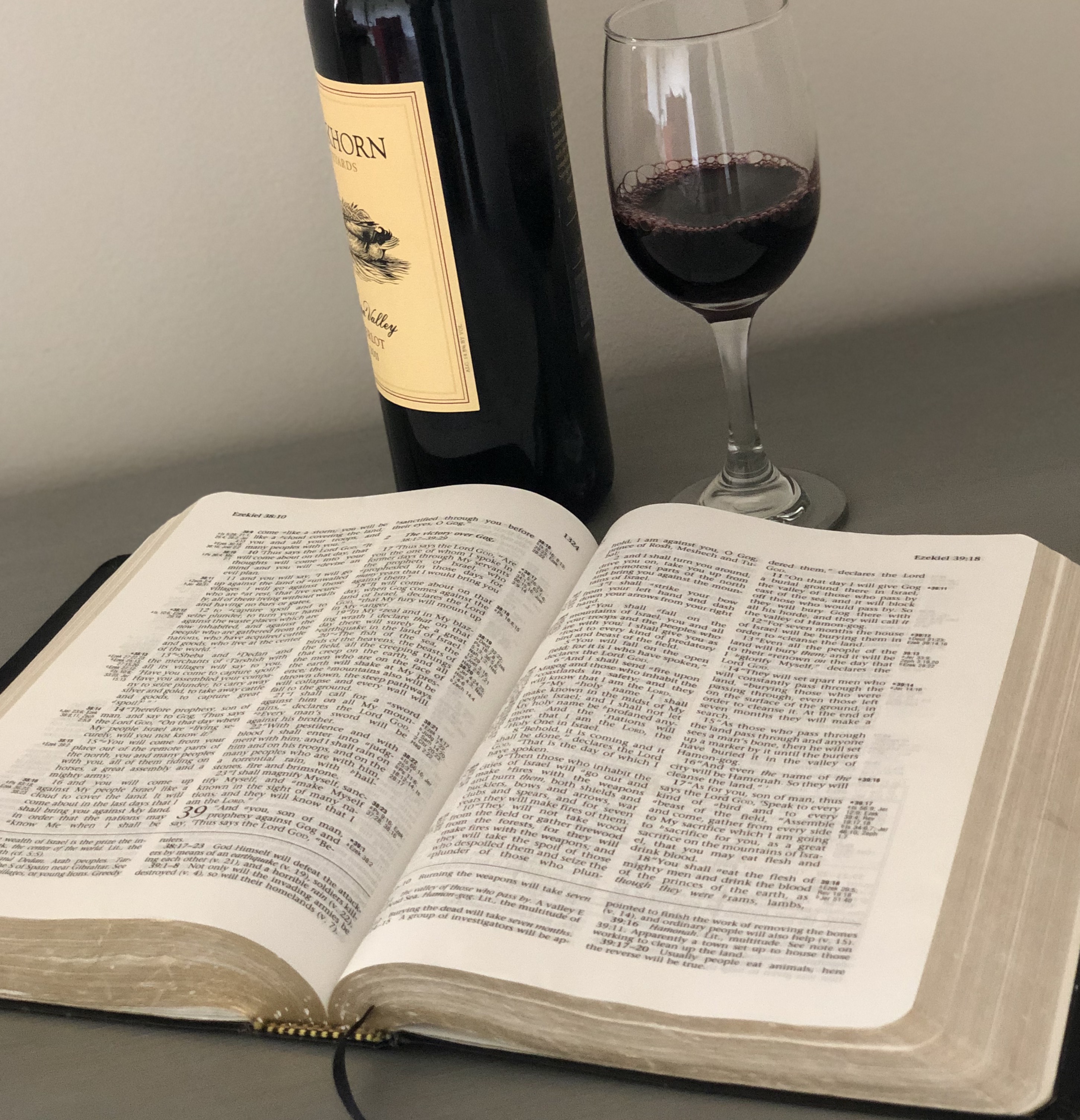
My friend Steven and I recently started something we call the Rhythm Section’s Guide to Mixology. He had the idea to create instructional videos of us making cocktails for our wives, while helping viewers “up their drink making game.” Between our friendship and the chemistry we already have playing in a band together, we knew it would be a creative way to do something fun together with our wives.

So what’s the conflict?

First, I’m confident not all of my Christian friends approve or agree with what we’re doing. While we certainly never advocate over-indulgence, nor partake in most of the concoctions ourselves, alcohol consumption is still one of those areas where Christians widely disagree. I’m no biblical scholar, but this is one of those commandment versus conviction situations that is highly sensitive and can create confusion or misunderstandings. So I’m concerned with how some feel about this venture. There’s also this paradox: even if it isn’t inherently wrong, neither do I want to cause anyone to stumble (cf 1 Cor 10.31). Self-doubt is seldom in short supply for me.

Secondly, I take great care, time, and effort providing essays here that are meaningful, insightful, helpful, or mildly entertaining. While I deeply appreciate every follower and all the shares, likes, and comments, our first Rhythm Section’s Guide to Mixology episode garnered more views and feedback than many of my articles, combined.

Oof. Not only is that disappointing, it may also be a sign it’s time to add something to this project, as well. More to come on that.

Here’s a few other head-scratchers to ponder, paradoxes or not.

I can’t see the forest for the trees; gotta be cruel to be kind; Tequila is mezcal, but mezcal is not necessarily tequila (thanks Matt and Dave); bourbon is whiskey, but not all whiskey is bourbon; champaign is wine, but wine is not necessarily champaign.

These are clearly not the best examples of paradoxes or conflictions, so I encourage you to comment below with a few of your own.

I also encourage you to research an old article by Jerry B. Harvey where he explains the Abilene Paradox. The Abilene Paradox says that the “…inability to manage agreement, rather than conflict, is the single most pressing issue of modern organizations” and that “Organizations frequently take actions contrary to the desires of any of their members, and defeat the very purposes they set out to achieve.”  

Paradox for thought.

Get Strong. Be Strong. Stay Strong.

https://www.vocabulary.com/dictionary/paradoxical

Six Foot Cup

I am at odds with myself. I have become increasingly conflicted. I feel this way; then that way. I’m at peace and content; then I’m stressed and unsettled. This statistic is concerning; but that doesn’t add up. Remote work is getting old; but I don’t want to go back to work. It’s reasonable to respect the seriousness of the pandemic and not be careless or reckless; but until the vaccine is predominant, it’s obvious the virus is going to do what it wants to do, restrictions or not.

What explains those who diligently wear masks, socially distance, and adhere to every recommendation and edict from the experts, yet are still infected? What explains how some states’ restrictions are driving small businesses and restaurants into extinction, while others, with fewer restrictions, have lower death rates, citizens are happy, and businesses thrive? It seems the things we think are most helpful aren’t a silver bullet after all, and things we think are most perilous maybe aren’t as devastating as we thought.

I liken it somewhat to parenting. You can do everything wrong and your kid will still turn out alright; you can do everything right and your kid will still take a left at Albuquerque, delivering indescribable anguish.

Point: Many people have done everything right, yet still catch COVID.

Counter-Point: Many people have been careless, nonchalant, or downright rebellious to recommendations, yet they’re doing fine.

Truth: There is a worldwide crisis.

Sad-Truth: Political posturing has been rife throughout the crisis…on all sides.

I grieve for what our country has become. No longer a shining example of democracy to the world, we have lost a common sense of dignity and respect. Peaceful protests are one thing. But antagonism has led to months of destructive civil unrest, disobedience, death, and millions in damages. The U.S. is supposed to be the world’s democratic leader. Now we look like a dysfunctional junior high school. Our political ‘leaders’ and elected officials have cast aside statesmanship, diplomacy, and decorum in favor of hissy-fits and name-calling. Taking credit or blaming others for something clearly beyond anyone’s complete understanding takes precedence over doing the right thing.

As a man of faith, I’m called to be subject to governing authority, and to be anxious for nothing (Rom 13.1; Philippians 4.6). But I am admittedly frustrated and confused. My heart aches for those who have lost loved ones to this wicked affliction. And for people losing their life savings and livelihoods because they aren’t allowed to responsibly resume reasonable, careful business operations; or go back to work at the jobs necessary to do so.

What does all that have to do with six foot cups of coffee? Everything!!

These are tough times even for the strongest among us. People’s mental, physical, spiritual, and emotional well-being have been challenged greatly since this began. Humans are social creatures; nearly a year of social distancing and isolation has been devastating. We need each other!

Hollywood might be onto something, for at least one pivotal scene always seems to take place in a booth or at the counter of a classic roadside diner. Heroes, villains, fugitives, unlikely lovers figuring things out, or conspirators planning a heist. Best done over a hot cup of Joe!

There’s nothing quite like sitting down with a friend. Self-care, buddy-check, confessional, solving world problems, venting. Whatever the reason, it’s good and necessary. I love my alone time…but I need people too! Bonus when it’s without agenda or drama or judgment or problems that need solved.

Such was the advent of the ‘six foot cup’.

It came about during a virtual team meeting. As I expressed my concern over current events and the well-being of my people, I also shared some of my own struggles with so much social isolation. I end meetings imploring them to call, text, email, or video me any time if they need anything or just want to talk. Pleasantly, a number of them have. On this occasion I offered to meet anywhere in the state for a ‘socially-distanced’ cup of coffee.

Immediately, a trusted colleague and friend – intuitive to my need, and perhaps desiring some adult conversation himself – messaged to take me up on that “six foot cup”. Therapeutic for us both, we’ve since met twice.

I refuse to live my life in fear of this pandemic. But I likewise refuse to allow my actions to cause others concern or to stumble. I continue to respect the well-being (and fears) of others and adhere to the precautions of wearing a mask and not being careless in contact or interactions with others. These are not unreasonable expectations for anyone.

Maybe it is also reasonable not to pretend to know things we don’t; not to regurgitate dubious statistics; not to buy into or create false narratives; or not to concern ourselves with outward appearances…while being filled with questionable or self-serving motives.

“Woe to you, because you load people down with burdens they can hardly carry…” (Luke 11.46)

“Everything they do is done for people to see.” (Matt. 23.4-5)

God is in control. We are not God. Be wary of those who think they are.

It’s a miracle he hasn’t already smote every one of us for our selfishness, disobedience, and unfaithfulness.

Thanks for the six-foot cup, Karl. Next week?

2nd Annual Year in Review

As the calendar turned two years ago I quoted David Jeremiah, who wrote: “A compassionate man does not stand detached from the sufferings of others.  Rather, he steps into the world of the hurting and feels the pain and anguish of the one suffering.” The world has been hurting, and many suffered greatly in 2020. Maybe that quote would be better served to start 2021.

The premise behind beyondstrength.org is that strength is more than just being physically strong. It’s also about finding strength in weakness, and helping others get strong, be strong, and stay strong. Thank you, 2020, for proving that premise to be necessarily self-evident.

There’s no sense lamenting the things here we’ve lived ad nauseam the past 10 months via revolving news networks. Instead, I will continuing the fledgling tradition of recapping my blatherings from the past year.

Surely you read, enjoyed, related to, and benefited from all of my writings the last 12 months?! On the outside chance you missed any of these ‘life-altering’ posts, here’s a summary of Beyond Strength articles from the dumpster fire of a year called 2020.

Cause for Delay (video): Starting the year already behind schedule, I bought time by sending a video update from the island of Lesvos, Greece. I was there with a short-term mission team providing humanitarian support to refugees at Moria Camp. It was an amazing experience and added valuable context to my life experience and walk of faith.

The Leadership T.R.A.P.: The article used the acronym to compare and contrast Task versus Relationship focused leaders and Authority versus the Power-focused leader. Tasks tend to be one-dimensional…just get it done. But tasks and overall mission are best accomplished when relationships built of genuine care for your people come first.

Free Samples of Forgiveness: I get bogged down dwelling on my mistakes or how I’ve been wronged by others. Counselors call that ruminating. My struggles in this area are rooted in difficulties accepting and granting forgiveness. I’m committed offering forgiveness more freely and being grateful for forgiveness I’m granted. “For if you forgive other people when they sin against you, your Heavenly Father will also forgive you. But if you do not forgive others their sins, your Father will not forgive your sins.” Matt. 6.14-15

March Forth: What better month than March to march forth toward fulfilling your purpose, achieving your goals, or making the world a better place?  I suggested some ideas like starting a blog or other venture; starting a reading program; volunteering; or getting your fitness goals on track. How did you do?

Well That’s Fabulous: Chances are you’ve seen or heard the abbreviation ‘wtf’. If seeing it makes you uneasy, don’t be. It stands for Well That’s Fabulous. WTF was a discussion about the disturbing trends being witnessed within the pandemic. This is an unprecedented crisis; no one person, organization, or government has all the answers. People should stop blaming others; stop trying to advance personal and political agendas; stop arguing about who should have done what, when; and stop trying to be an infectious disease, economics, supply chain, business, or political expert. Instead, start being more caring, compassionate, cooperative, humble, and kind.

Conspiring for Good: Election interference and virtually everything surrounding COVID-19 generated rife theories of conspiracy or malfeasance that continue to thrive. Whether conspiracy theories do more harm than good or serve to help maintain proper balance in the world, it can take years for the truth to be revealed…and even then there will be those who doubt. Conspiracies make for great entertainment, but also cause great divisiveness. Commit to conspiring to do good.

Be the Solution, Not the Problem: Here were a few ideas I shared to be more of a solution than a problem.

  • Make room for God in your life. When we understand our own unworthiness compared to a Holy God, we tend to be less of a problem for others.
  • Stop claiming the misfortunes of others as your own in some attempt to justify living however you want, or as an excuse for your own bad behavior. “Let your light shine before others…” (Matt. 5.16)
  • Embrace diversity. Enable diversity to foster and thrive by treating everyone with dignity and respect.
  • Take ownership of your mistakes and shortcomings. Owning your mistakes is solution-oriented; blaming others makes you part of the problem.
  • Pick up after yourself; leave things better than you found them; say please, thank you, and I love you more often.
  • If you see someone struggling or in need, help them. Saying to yourself, “It’s not my problem” is part of the problem.

Heard, Understood, Acknowledged: An essay about the challenges of interpersonal and organizational communication. Sometimes it’s not what I say, but my delivery that sucks. Like other challenges, there’s probably no easy answer to solving communication problems. But I have found timeliness, openness, transparency, and over-communicating helps. Can you hear me now?

Gains without Pain: There’s something to be learned from pain in our lives, be it physical, emotional, psychological, or otherwise.

  1. Recognize its warning
  2. Protect the injured area(s)
  3. Strengthen surrounding structures that are weak
  4. Properly address and treat the root cause
  5. Don’t bury, numb, or mask it with medication, over-indulgence, or risky behavior
  6. Avoid it when it’s causing damage or grief

As we move on from 2020 into the new year, I pray you’ll have a Happy(er) New Year, you’ll continue to follow along, and that you’ll make a positive difference in others’ lives.

“A life is not important except in the impact it has on other lives.” – Jackie Robinson

Keep doing great things!

Get Strong. Be Strong, Stay Strong.

Gains Without Pain?

No Pain, No Gain! A familiar expression barked by trainers, a well-used mantra for gym-rats. From a muscular development or fitness improvement standpoint it’s true. It’s tough to make gains if you don’t push yourself, and pushing hurts sometimes. As someone who has suffered from chronic headaches and migraines since adolescence, unfortunately I know pain without gain well…and finding ways to press on has been the only option. But I’ve recently been reminded ‘working through’ pain is not always best.

In an effort to find a cause and eliminate what no one wanted to talk about, around the first or second grade (early 1970s), I was subjected to a brain scan. It was a fairly horrifying experience for a little guy, where dozens of wires were poked into the scalp all over my head. It was made worse by A) the probes kept falling out, so they were poked into my skin and then glued to my head; B) a scary-looking, impatient, unsympathetic nurse ripped half my hair out trying to remove the glue afterwards. I’m not sure I ever screamed and cried so much before or since.

I think I had endured an Electroencephalogram. MRIs weren’t quite on the scene yet, but honestly those aren’t my favorite way to spend an afternoon, either. The good news is there was no tumor, aneurysm, or anything else that concerned doctors. The bad news is 1) there was no explanation for the already chronic headaches I still have to this day, and 2) my dad had the perfect lifelong icebreaker and punchline at my expense: “They did a brain scan on David, but they didn’t find anything!” Figuring 45 years of persistent headaches can’t be a good thing, I had a MRI done last year, just in case. Dad: “How did your brain scan come out?” Me: “Good.” Dad: “They didn’t find anything, huh?!” It never gets old.

Electroencephalogram may explain the hairdo.

Chronic intense pain has nearly always been a ‘normal‘ part of my life.

On the bright side, pain is one of the body’s sensors to indicate something is wrong. In his book “Where is God When it Hurts?” Philip Yancey reminds us “Pain sensors loudly alert [our bodies] to danger…”. He says absent pain’s warning, or ignoring or silencing it without heeding it, is dangerous and can lead to greater harm. That’s where the not-so-bright-side comes in.

Ignoring pain, pushing through, deadening it, or turning it off altogether is dangerous and undermines the body’s natural warning systems. Like removing the batteries from your smoke detector or putting tape over your check-engine light because you’re tired of looking at it. Too often we get into the habit of treating pain’s symptoms and ignoring the root cause. This can be through medication, alcohol, or living with reckless abandon. The result is often more damage. Pain is telling us something. We are wise to listen.

I’m not just talking about physical pain.

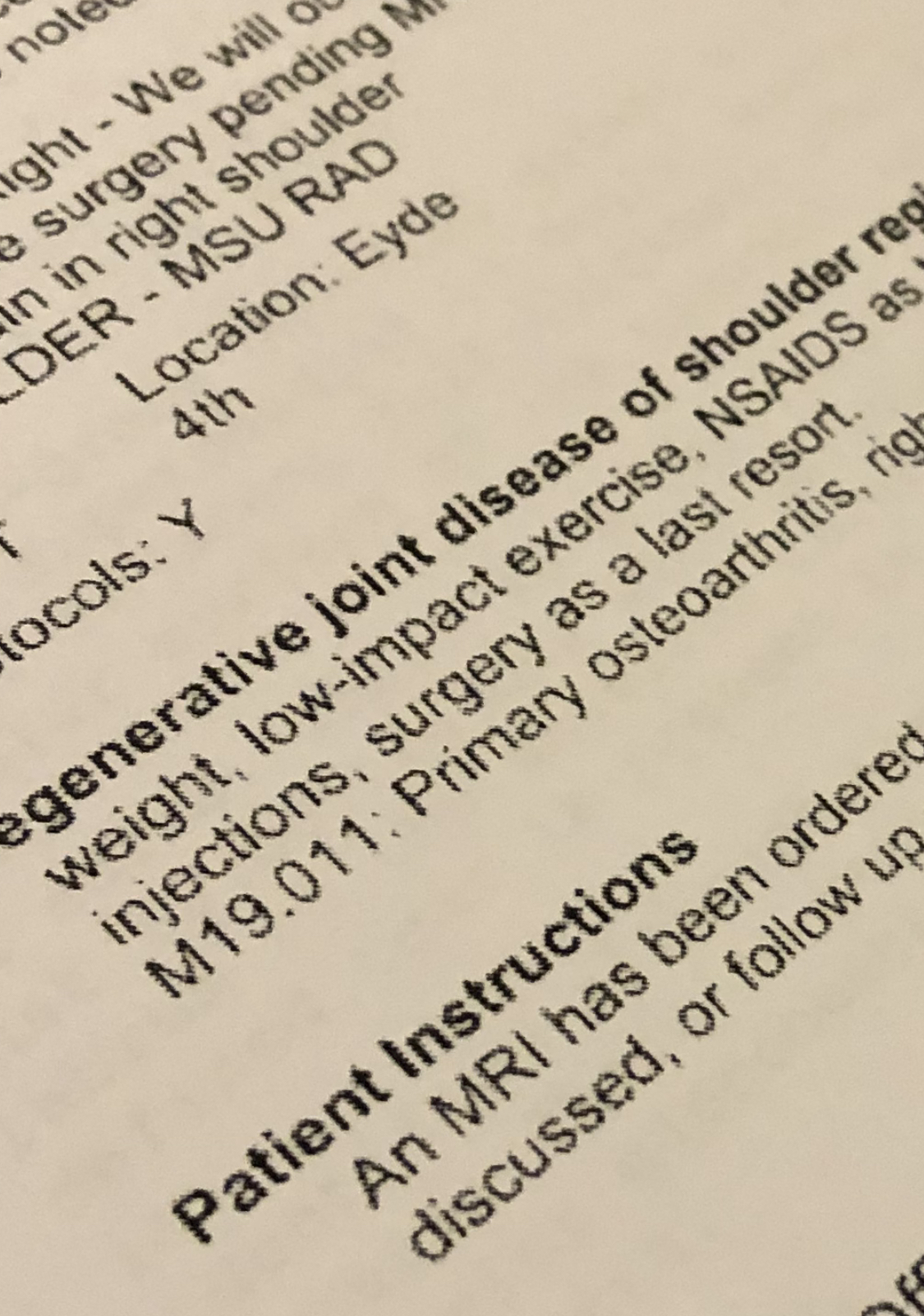
I have become so accustomed to living with the pain of migraines that when other things hurt, I just try to ignore or deaden it until it subsides. Sometimes it persists so long that it gets drowned out in the ‘noise’ for a period of time it’s not as noticeable. Like people living near railroad tracks or the effect white noise can have on the constant ringing in my ears. But, like ignoring emotional pain that needed attention and psychological pain from unresolved vicarious trauma, I’ve learned pushing through the pain of degenerative joint disease (advanced arthritis) in my shoulder just causes more damage. Not only has the result been near constant discomfort and improper functioning, failure to properly deal it has weakened the surrounding structures.

Obvious symmetrical inconsistency resulting from improper shoulder function.

In just a few weeks of physical therapy I have come to understand I can’t ‘fix’ this arthritis…I’ll live with shoulder pain the rest of my life. But I can strengthen the right areas, re-teach myself proper alignment and function, and learn to listen and respond appropriately to pain. Sometimes that means not pushing through discomfort.

I’m not just talking about my shoulder.

There’s something to be learned from this about pain in our lives; physical, emotional, psychological, or otherwise.

  1. Recognize its warning
  2. Protect the injured area(s)
  3. Strengthen surrounding structures that are weak
  4. Properly address and treat the root cause
  5. Don’t bury, numb, or mask it with medication, over-indulgence, or risky behavior
  6. Avoid it when it’s causing damage or grief

“Like a grain of sand or other irritating substance that finds its way into the shell of an oyster eventually leads to creation of a beautiful pearl; so an injury, irritation, or wrong in our life can become a great blessing and the means to enrich us.” – Karl P. Buswell

My prayer is that you will somehow find blessing in your pain.

Get Strong. Be Strong. Stay Strong.

Yancey, Philip. (1990). Where is God when it hurts. Grand Rapids, MI: Zondervan.