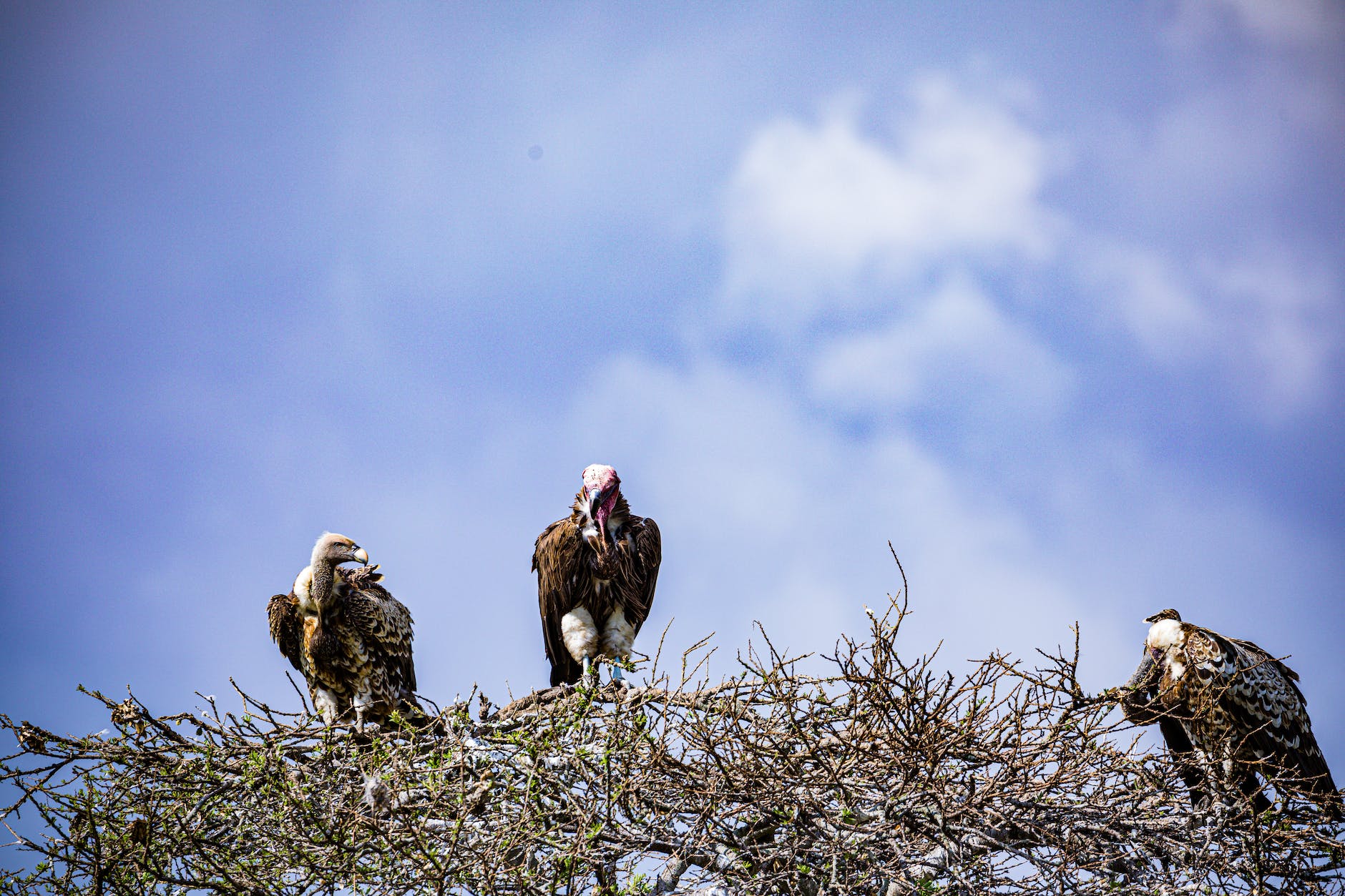
vultures perched on leafless tree under blue sky

Vultures Will Gather

I recently read a passage in the Gospel of Matthew I struggled to make sense of, which is not unusual. There are many things I don’t yet understand about God and his word. But I’m okay with that…a divine Creator completely understood within human reason wouldn’t be much of a god, anyway. A. W. Tozer seemed to relate a similar issue when he wrote, “Evils…will seem evils only because we cannot read the secret script of God’s hidden providence.”1

The passage contained this verse: “Wherever there is a carcass, there the vultures will gather.” (Matt. 24.28)

Coincidentally and perhaps not-so-completely-unrelated, I first learned about Dia de los Muertos (Day of the Dead) in college Spanish one long-ago fall semester. As I write this it’s Halloween time. I’m embarrassed to admit I used to confuse the two very different holidays.

A traditionally Mexican holiday celebrated within the first days of November, Dia de los Muertos is a time-honored observance of both life and death, abundant with bright colors, music, food, drink, and expressions of love and respect to honor the souls of deceased loved ones.

On the other hand, if ever existed any redeeming aspect of honoring saints at Halloween, that’s largely devolved to themes of frightening costumes, dubious behavior, witches, mayhem, and yes…death.

*Not an actual carcass or crime scene

Watch any old western and you’ll learn circling buzzards mean carcasses nearby. There isn’t space here to deep-dive my theological confusion, but it appears Matthew’s passage, like Luke 17, points to the end times and coming of God’s Kingdom. The widespread carnage, stench of death, and vultures everywhere will evidence the judgment.

But wildfowl aren’t the only creatures attracted to death or affliction. Metaphorically, human vultures are often busy circling, fascinated with the macabre and eager to prey on the downtrodden. I once had to fight off a vulturous hoodlum bent on ridding an unconscious victim of his wallet, even as paramedics and I worked to save his life.

And these familiar buzzards: ambulance-chasing attorneys lining their pockets with the currency of others’ misfortune; slippery televangelists milking the last few dollars of unsuspecting God-seekers; heirs historically uninvolved, conspicuously motivated when estates are settled; rubbernecking gore-mongers jamming traffic and compounding mayhem, instead of minding their own driving; or streaming fanatics unable to find anything as entertaining as bingeing the latest true crime show or similar exploitation of human anguish.

Incorrect assumptions, uninformed assertions, irresponsible gossip, careless rumors, and outright slander are especially hurtful, and too often the hallmarks of human vultures in our lives. Unlike the telltale orbit of winged predators, these ‘birds’ are especially hurtful and negligent because their plundering too often happens behind the backs of their troubled, downcast, or otherwise vulnerable prey.

Fortunately, not all are quite so iniquitous. Like colleagues circling your office or siblings dive-bombing your bedroom ready to snatch whatever goods and chattels might be up for grabs upon your departure. Of course, it’s possible you’ve just overstayed your welcome and they’re just waiting for the smelly log jam of ‘dead wood’ to clear…

Vultures will gather. So what’s a cadaver to do?

  1. Live. One sure way not to be a target of vultures is to not be dead. Be physically, mentally, emotionally, and spiritually alive. Stay busy. Exercise, go for walks, read, pray, listen to music, sing, dance. Enjoy life and appreciate God’s beauty in people and the world.
  2. Love. Few people, even buzzards, wake up in the morning determined to hurt others. Maybe they’re oblivious to the pain they cause, or they just don’t care. Either way, that’s their issue…not yours. We have no idea what may be going on their life or the personal demons they fight. Maybe it’s divorce, addiction, abuse, illness, death of a loved one. Instead of being just another angry bird, be kind and compassionate. There’s a local business nearby that routinely employs people down on their luck or with checkered pasts. Affectionately referred to as ‘reclamation projects’, they help people when everyone else has given up on them. Second chances are part of their organizational culture and something we can all learn from. Everyone stumbles. Instead of throwing the ‘baby’ we once esteemed out with the bathwater, remember and appreciate all the positive things they’ve done. Just love them and give them the chance to keep doing great things.
  3. Laugh. Don’t take yourself so seriously…laughter is good medicine! Jump in a pile of leaves, play games, dress up for Halloween. A youthful heart beats strong and crow’s feet are much more attractive from smiling than stress.
  4. Learn from the goose. Buzzards are solitary, opportunistic predators. Geese, on the other hand, fly together, share responsibility for leading the flock, and care for one another when sick or wounded. That’s leadership 101…and pretty good relationship advice, too.
  5. Lean into God’s hidden providence. It’s easy to set our faith aside when things are going well, but the time to become acquainted isn’t in the midst of catastrophe. Seek to know God better now, and more will be revealed; in good times and bad. Walk by faith, not by sight…God is in control.

Get Strong. Be Strong. Stay Strong.

The vultures didn’t mind the slow service.

https://www.nationalgeographic.com/travel/article/top-ten-day-of-dead-mexico

https://www.history.com/topics/halloween/history-of-halloween

1Jeremiah, David (2014).  Quest devotional seeking God daily. San Diego, CA: Turning Point.

Climate Change

A recent sermon at church was a continuation in Hebrews 12. I had my ‘travel Bible’ with me that day. It’s been all over the world with me, and is not unlike me: simple, old, and tattered. Edges frayed, falling apart, and the binding is held together with duct tape. It’s time for a change.

Simple. Old. Tattered. Essential.

One theme of Hebrews 12 is restructuring one’s life around the ongoing purposes of God. In other words, to organize differently, convert, change. The author also writes of running the race of faith with perseverance and gaining strength and maturity through trials, pain, or hardships that ultimately result in “a harvest of righteousness and peace…”.

Excluding the economy, I certainly don’t assess retirement thus far as pain, hardship, or trial. But while the perpetual pulse of stress is gone, I haven’t felt quite ‘at peace’ as I expected. Restless sleep and trouble relaxing persist, as does anxiousness and feeling unsettled. A brief ‘honeymoon period’ of bliss has passed. I even relapsed into some edginess, which was “sorely missed”…by no one.

I’m reluctant to attribute my disquietness to a single source. I imagine instead it’s a combination of factors acclimating to the changing season of my life. But if I’m being honest, a work issue that lacked closure, and now impacts more than just its own disposition, has leveraged hard against a pleasing adjustment to retirement.

If you’re reading this, you know beyondstrength.org is a ‘motivational ministry’. My mission is to provide encouragement, make positive change in my life, help others do the same, and make the world a better place. I even doubled-down in my last article about my desire is to live humbly without entitlement to anger or offense. To be unoffendable, as Brant Hansen calls it.

Ironically, the issue above involves a situation where I offended someone. It wasn’t intentional or malicious. In fact, I wasn’t even aware until being told, secondhand, that a complaint was made. My heart aches knowing I unwittingly hurt someone, made worse by never having the chance to address the matter directly or otherwise make it right.

While human nature tempts me to take it personal or question the timing and motive, Brant Hansen reminds me that “We simply can’t trust our judgments of others. We don’t know what they’re really thinking, or their background, or what really motivated whatever they did.” So why spend time, effort, or emotional energy on things outside our control?

But God is in control. And he sees things we don’t.

We only see what’s in front of us…the here and now. God sees the ‘whole parade’ (as says the Go Fish song).

But I’m not going to lie…this hurts. A lot.

I know who I am and what I stand for. Despite my shortcomings, I work hard to be a source of blessing and edification to others. Some don’t always see it that way, and that’s ok; I don’t know someone else’s private motives or what’s in their heart. It’s not my job to judge motives, anyway.

My job is to find significance and satisfaction in my relationship with God, rather than in the approval or admiration of others.

Still, I can’t make people like or respect me. And in some cosmic conspiracy against my emotions, I actually care what people think about me.

Long ago, on a page of that tattered Bible, I had written “Maturity is the result of how we respond to trials, not the trials themselves.”

I certainly haven’t arrived yet, but I’ve made considerable progress responding to trials in my life. I’m not the same man I was. I also know God’s not finished with me yet.

In his book The Men We Need, Brant Hansen shares an applicable quote from Greek philosopher Heraclitus: “No man ever steps in the same river twice, for it’s not the same river and he’s not the same man.”

Another philosopher, Marcus Aurelius, astutely (albeit harshly) wrote this gem: “You are an old man…so no longer be pulled by the strings like a puppet…no longer either be dissatisfied with your present lot, or shrink from the future.”

I’m thankful for where God has me right now, and ready to adjust to whatever he has for me next.

Am I disappointed? Yes. Persecution is painful; it wounds both body and soul.

But I refuse to let a dubious blip on the ending credits of my career overshadow an entire life of serving others with courage, honor, dignity, and respect.

And for those who judge me differently because of the blip, there’s a relevant passage in the Gospel of John…something about casting stones.

Changing ‘climate’ can be as easy as adjusting the thermostat or going south for the winter. I’ve found acclimating to change isn’t quite that simple. Accordingly, seeking God and growing stronger, wiser, and more faithful in retirement is my climate change strategy.

God is good. I trust him. And I believe he’ll sort it all out and set things right in the end.

“Wait for the Lord; be strong and take heart and wait for the Lord.” – Psalms 27.14

Get Strong. Be Strong. Stay Strong.

Hansen, Brant (2022). The men we need. Grand Rapids, MI: Baker Books.

Hansen, Brant (2015). Unoffendable. Nashville, TN: W Publishing Group. 

Robertson, Donald (2020). Meditations the philosophy classic (based on The Thoughts of Emperor M. Aurelius Antoninus, translated by George Long). West Sussex, UK: Wiley

Source: LyricFind Songwriters: Franzel / Troccoli / Wirkowski Parade lyrics © Bird Wins Publishing, Capitol CMG Publishing, Sony/ATV Music Publishing LLC, Universal Music Publishing Group