
Failures & Faith
God looks not at our failures, but at the sincerity of our faith. The truth of that statement is found throughout history. Consider those honored as ‘Heroes of Faith’ by the author of Hebrews, who despite failing miserably earlier in life, were used mightily by God because of their faith.
Here are a few.
Abraham, more concerned for his own well-being than his wife, passed her over to Pharaoh as his sister; later, his impatience with God’s timing would lead to hurt feelings and an unnecessary and unpleasant family dynamic. Moses, long before leading his people out of Egypt, killed and buried an Egyptian, then hypocritically tried to play peacemaker between two of his kinsmen. Both Moses and the valiant Gideon would doubt their abilities, self-worth, question God’s instruction, and resist their calling. And like many other men, the mighty Samson and King David were both enslaved to passion, self-indulgence, and captivated by beauty.
Stories like this aren’t uncommon. Industry leaders, CEOs, Hollywood icons, athletes, and everyday people are stumbling masters of imperfection. Yet many contribute greatly and attain high levels of success and achievement. So why is this important, and why now?
Timing and proximity.
For a while now, my pastor has been preaching through the book of Hebrews. Chapter 11 focuses on triumphant faith. Examining those highlighted as heroes of faith gives me hope…even heroes fail. But faith endures, and by it they “…conquered kingdoms, performed acts of righteousness, obtained promises, shut the mouths of lions…escaped the edge of the sword, from weakness were made strong” (Heb. 11.33-34; emphasis added). Their faith gained them approval from God, because faith is evidence of the heart. And God looks at our heart, not how many mistakes we make.
But faith will be tested.
Unfortunately for those who dislike discomfort, the pastor points out that for faith to mature it must be pressed…as olives are to making oil. Faith is refined (matured) in the process of being crushed.
It seems failure isn’t necessarily a bad thing.
I don’t know where you land on the coincidence versus serendipity versus providence spectrum, but just days ago Tim Tebow, a man I respect for his faith journey, encouraged followers to embrace failure as a growth and learning opportunity. Part of his post read “Failing doesn’t make you a failure”. While he’s experienced some incredible success in his life, he’s also experienced significant disappointment. His faith still shines above it all.

I don’t know him personally, but I expect he would agree that faith is something we experience. Whether we live to be 100 or our days are cut short, faith is a journey, not a destination. And sometimes God uses even a short life to make a lasting impact.
It’s not comforting, but people of faith know that sometimes God’s greater purpose outweighs temporary discomfort.
“Counting on the future is folly.” – Charles Spurgeon
We are two years into a pandemic we were told would be under control within a couple of weeks. Many have lost faith in authorities and experts because of their inability to provide consistent guidance or expected results. Don’t count on the future.
Those who lost friends or loved ones to COVID likely had their faith tested. Unrelated to the pandemic, my family and others close to me have experienced incredible pain due to the unexpected loss of loved ones during that time. Two, in particular, were taken from their young families undeservedly soon. It may be little comfort to those grieving, but each of them lived a life of faith and powerful testimony, leaving behind a lasting legacy and impact.
Faith is tested in other ways, too.
It’s difficult to explain the level of anguish and heartache over an estranged child, wayward and spiraling downward; consequences of poor decisions come to fruition near rock bottom.
The olive press of parenthood isn’t always a pleasant journey of faith. Flaming, blaming, hateful arrows launched from the tongue of a broken spirit aren’t easily ignored. They sew seeds of doubt in even the strongest parent.
Are my own failures to blame? Whose faith journey is this, anyway?
I’ve had both insignificant and epic failures. I still do. I’m ashamed to admit that I’m not so unlike those heroes of faith mentioned earlier. I’ve been impatient with God’s timing; hypocrisy isn’t foreign to me; I’ve doubted my worth, downplayed my abilities, resisted my calling, and questioned God’s direction.
And if ever a person personified their biblical namesake, it’s this David.
I long for the ‘good old days’, but as I pointed out in the preview to this article, maybe the good old days weren’t all that great either. Still, times certainly seemed simpler then.
I think it was Jimmy Buffett who said that living well is the best revenge. But vengeance isn’t ours to wield and many of us have some letting go to do.
But I see his point.
Living well with a faithful heart, despite our proclivity to stumble, may help today’s days be the good old days we seek.

Trust in the trustworthiness of God.
Get Strong. Be Strong. Stay Strong.
Tim Tebow quote retrieved from https://www.linkedin.com/feed/update/urn:li:activity:6900445218035089408/

Finishing Well

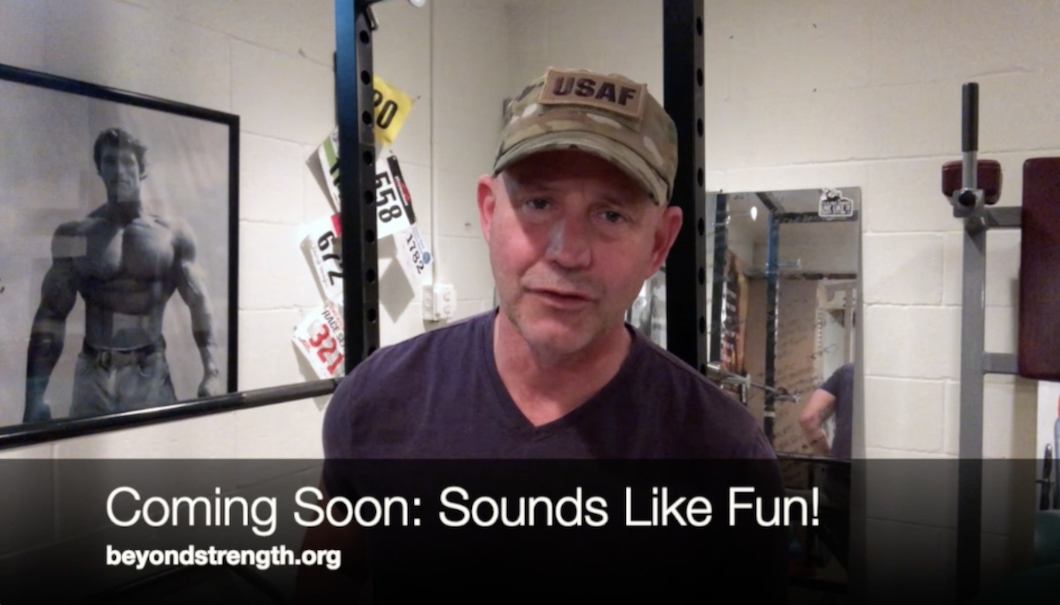
When I recorded the video preview, this article was intended as motivation to finish well as I close in on retirement. I had no idea the next two weeks would be a collision of parallels between finishing a career well and finishing a life well. With the unexpected passing of my mother-in-law, and two other funerals the same week, the connection was unmistakable.
Contextually, hints of resentment started percolating and I didn’t like it. Save for a few disappointments, I’ve had an extraordinary career…I refuse to spend the last few months of it embittered. A little self-reflection revealed two primary issues conspiring against this emerging, unwanted disposition.
Too many decisions are made for the primary benefit of those making them. That’s nothing new. What is new has been the perfect storm of social, civic, and public safety upheaval, resulting in declining sentiment toward policing and melodramatic policy decisions driven by political activism. Progress is good; change is necessary. But not when it benefits some to the exclusion of others. What once was among the noblest of professions is now one in which contempt and disrespect for those sworn to serve and protect has become an acceptable norm.
The criminal actions or irresponsibility of a few must not diminish the honor and distinction with which the vast majority of public safety professionals serve. Many who have dedicated their lives to protecting and serving are exhausted and anguished. The current environment creates the potential for a profession that once attracted the altruistic and humble to instead draw those primarily motivated by power and authority. That’s not progress. But neither is it something I have control of.
The second issue is unforgiveness. I have too-long held onto hard feelings about lost opportunities. Two were blatant instances of favoritism, bias, and partiality; the others less obvious, but no less disappointing and no less wrong. Unchecked, these types of inequities create an environment where people don’t feel psychologically safe, and some simply stop trying; helpless to change things and afraid to speak out.
That’s where I eventually found myself. Hurt, ruminating, and waiting for an apology that will never come. Empathy and healing aren’t high on the list of priorities for the leader, husband, wife, father, mother, or friend unwilling or incapable of apology. Another thing I have no control of.
What is within my control are my attitude and actions.
In his book The Socrates Express, Eric Weiner quotes Gandhi as saying that no man “…takes another down a pit without descending into it himself.” Said another way by a good friend recently as we lamented current events, “We only end on a low note if we allow it.”
Avoiding low notes and pits by controlling what I can, and letting go what I can’t, seems obvious. Accordingly, I choose to finish well; maintain a positive attitude; avoid engaging in biased or self-serving decisions; and continue speaking out against injustice…socially and within my family, organization, and my profession.
And I choose to forgive…with or without an apology.
Besides, believers are urged to “…not grow weary while doing good” and “…not lose heart.” (Gal. 6.9).
My mother-in-law, Joy, never grew weary of doing good. She was one of the kindest, gentlest, most genuine people on the planet, who lived out her namesake every day. I had the privilege of speaking at her memorial, during which this portion of my remarks both applies here and convicts me:
“I say this with not an ounce of pride, ego, or self-serving motive; this woman, this most beautiful and tenderhearted of human beings, adored me. An adoration I never deserved. She was one of the few people I have ever known who truly loved unconditionally. No matter how many times I messed up, was abrupt, spoke unkindly, or hurt her daughter in some way, she never stayed angry or judged me. Instead, she was always the first to forgive me. I will never understand why she felt that way about me, or why a guy like me was so blessed to be a part of this wonderful family…”
My mother-in-law lived well, and despite her untimely passing, finished well. I’m a better man because of her.
Likewise, notwithstanding some disappointments along the way, I’m also a better man because of the organization I’ve been a part of for nearly 30 years.
I mentioned two goals in the preview video: finishing well and decluttering.
Finishing well means setting aside my grievances, knowing what I can and cannot control, and adjusting my attitude accordingly.
Decluttering means ridding myself of unnecessary junk…literally and figuratively.
In some ways, my profession and organization are unrecognizable today. That’s not necessarily a bad thing…it’s just not necessarily my thing.
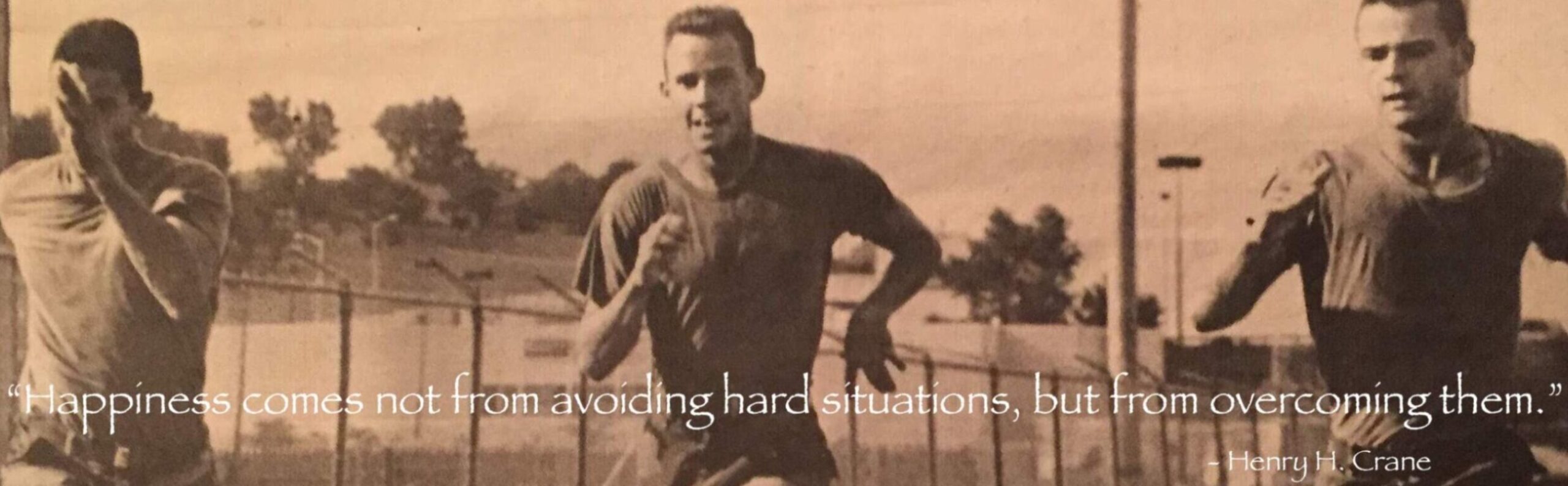
Nonetheless, I choose to run with perseverance to the very end.
“Therefore, since we are surrounded by such a great cloud of witnesses, let us throw off everything that hinders and the sin that so easily entangles, and let us run with perseverance the race marked out for us…” (Heb. 12.1)
Get Strong. Be Strong. Stay Strong.

Weiner, Eric (2020). The socrates express. New York, NY: Avid Reader Press.